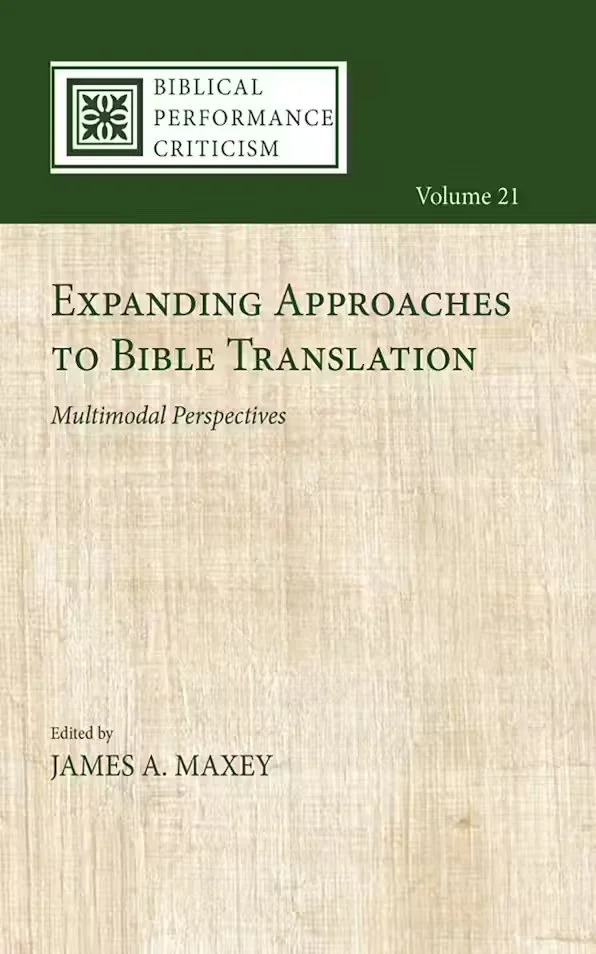
Expanding Approaches to Bible Translation
Multimodal Perspectives
Edited by James A. Maxey
(Cascade, 2025)
The assertion in this book is that translation is as fundamental to biblical material as performance--both in its history as well as in its research approaches. Translation in this sense is more than a transferal of meaning from one linguistic system to another. Bible translation highlights innovative connections and conceptions to biblical texts, in their promulgation, reception, and ever-changing nature. A predominant theory used throughout this book is social semiotic multimodality. This communication theory informs an approach to translation that expands beyond words to other semiotic resources. Sign Language, embodied performance, social media, theater, materiality, and many other types of multimodal communications inform translation. It is important to understand that the Bible is a translated experience. Translation reflects the various ways in which the Bible has been mediated and appropriated throughout history. It follows, therefore, that Bible translation, as a global activity, has been and continues to be influenced by the political and economic flows of history. Race, class, ethnicity, gender, sexual orientation, and other elements of our social locations directly influence the enterprise and results of Bible translation.
The Revelation of St John
Performed by David Rhoads
SBL 1998
Special thanks to the Endowment for Biblical Research (EBR), Boston, for permission to present the recording here. This presentation was given as part of the "Frontiers in Biblical Research" lecture series sponsored by the EBR. For more information, see ebrboston.org.
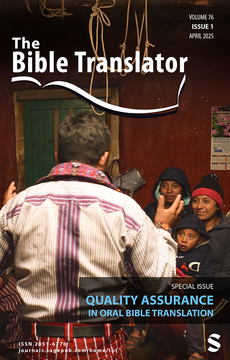
Quality Assurance in Oral Bible Translation
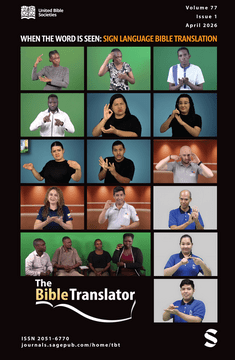
A special issue of The Bible Translator
Volume 76 Issue 1, April 2025
From the guest editor, Fausto Liriano:
As a foundation for this special issue, especially for readers who are not yet familiar with orality, Julian Sundersingh (United Bible Societies), a well-known name in orality and literacy studies, surveys the intricacies of orality and textuality and explores whether translations should cater to oral or written formats, considering the preferences of oral learners and identifying features relevant to quality assurance. Bayamy Tchande (Bible Society of Chad) explores how community participation contributes to quality assurance in OBT. Tobias Houston (University of the Free State) introduces a quality-assurance model based on loyalty to both source text and audience, integrating quality checks into the translation workflow, and discusses quality assurance in relation to the oral translation component and the subsequent written version of the translation, with case studies from his work in Mozambique. Bryan Harmelink (Wycliffe Global Alliance) examines the implications of multimodality for exegesis, translation, and quality assurance processes in Bible translation. Bronwen Cleaver (Institute for Bible Translation) and Justin Randolph (SIL Global) encourage translators to research and analyze local genres to achieve high-quality translations using forms within the corresponding genre in the receptor language, showcasing the Altai people’s sung translation of Psalm 133. Fausto Liriano (United Bible Societies) discusses the integration of cognitive memory principles into translation workshops in projects where the memorability and performability of the translated biblical passages are key aspects of quality assurance. Marlon Winedt (United Bible Societies) applies social semiotics to enhance OBT, introducing audio recordings of written Scripture into the conversation and discussing what criteria should be considered for quality assurance in that format. Robin Green Ulibarri (Seed Company) and Swapna Alexander (Faith Comes by Hearing) then discuss the rationale for transcription and present case studies, aiming to initiate a conversation on best practices for quality assurance in converting oral to print. Phil Ruge-Jones (Grace Lutheran Church) focuses on ensuring fidelity in translation, emphasizing a performance-based approach and cultural contexts in a project in Guatemala.
Report from SBL 2025 in Boston
November 22-25, 2025
Performance Criticism of the Bible and Other Ancient Texts

Biblical Performance Criticism: What Is It? How to Do It? Where Is It Going?
Sunday Nov 23 1-3:30pm
- Looking at Bible Performance Criticism from a Social-Semiotic Perspective
Marlon Winedt, United Bible Societies
https://vimeo.com/1140804796 - Biblical Performance in a Multi-church, Multi-user, Single Translation Context
Mark Penner, United Bible Societies
https://vimeo.com/1141166579 - Visual Resources and Persuasion: The Performance of a Pauline Letter in Dominican Sign Language
Isela Trujillo, United Bible Societies
https://vimeo.com/1141322597 - Your Great Learning Is Driving You Insane! Between Paralysis and Praxis in BPC
Zach Eberhart, Point University
https://vimeo.com/1141324286
Translation and Linguistic Issues in Apocalyptic Literature in Ancient Hebrew and Aramaic (with Linguistics of Biblical Hebrew)
Sunday Nov 23 4-6:30pm
- Movement, Spirit, and Prophetic Communication
Fausto Liriano, United Bible Societies
https://vimeo.com/1141568710 - The Masoretic Text as Performance
Aaron Douglas Hornkohl, University of Cambridge
https://vimeo.com/1141550657
Embodiment and Cultural Memory: Performance of Rev 13–14 (with John's Apocalypse)
Tuesday Nov 25 9-11:30am
- English Performance of Rev 13-14
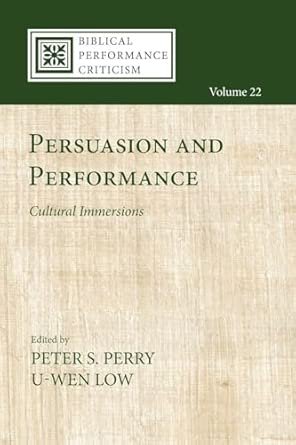
U-Wen Low, University of Birmingham
https://vimeo.com/1141572755 - Spanish Performance of Rev 13-14
Isela Trujillo, United Bible Societies
https://vimeo.com/1141574262 - Japanese Sign Language Performance of Rev 13-14
Facilitated by Mark Penner, United Bible Societies
https://vimeo.com/1141575958 - Responses by Megan Wines, Tina Pippin, and Travis West
https://vimeo.com/1141640240